Non-Locality: Action vs. Influence at a Distance
It is true that, as Bell’s theorem demonstrated, quantum theory is deeply committed to superluminal influence or coordination. But we have to distinguish between violations of Parameter Independence and violations of Outcome Independence (to use Abner Shimony’s distinction, Shimony 1984).
Mere violations of Outcome Independence require only a coordination between two widely separated entities. It does not require that any entity immediately produce a change of any kind in a spacelike-separated patient. In contrast, a violation of Parameter Independence involves one parameter’s changing another’s, despite their spacelike separation.
Negative vs. Positive Non-Locality
Negative non-locality occurs when an event at one location nomologically entails that something at a spacelike-separated location loses some stochastic causal power (active or passive) that it would otherwise have (holding fixed all the facts in the patient’s backward time cone).
This is how quantum collapse in the EPR experiment was imagined to happen in the Copenhagen interpretation. A definite measure of spin-up on the x-axis at one site necessitates the observation of spin-down on the x-axis at the other site, if spin in the x-axis measured. Hence, the one observation deprives the particle at the other site of its causal power to produce a spin-up measurement.
Positive non-locality occurs when an event at one location entails that something at a spacelike-separated location instantaneously gains a stochastic causal power or some other intrinsic feature that it otherwise would not have (holding fixed its backward time cone). This is how EPR correlations are explained in the deterministic version of Bohm’s mechanics.
Merely negative non-locality does not entail such action at a distance.
If two quantum particles belong to the same substance (what I’ve called a thermal substance), then it is easy to see how there could be negative non-locality linking them. All their causal powers are grounded in the substantial form of their common substance, and there is no reason why this joint power of the separated parts of the substance could not manifest itself in an instantaneously coordinated way, manifesting negative non-locality.
However, it seems that there are cases where quantum particles from two distinct substances can become entangled. How can the hylomorphist explain the resulting negative non-locality?
Entanglement of Multiple Substances?
In 1992, physicists Yurke and Stoler demonstrated that the Schrödinger dynamics of quantum mechanics will cause particles from two entirely separate sources to become entangled. Here is the setup of the thought-experiment (from their article):
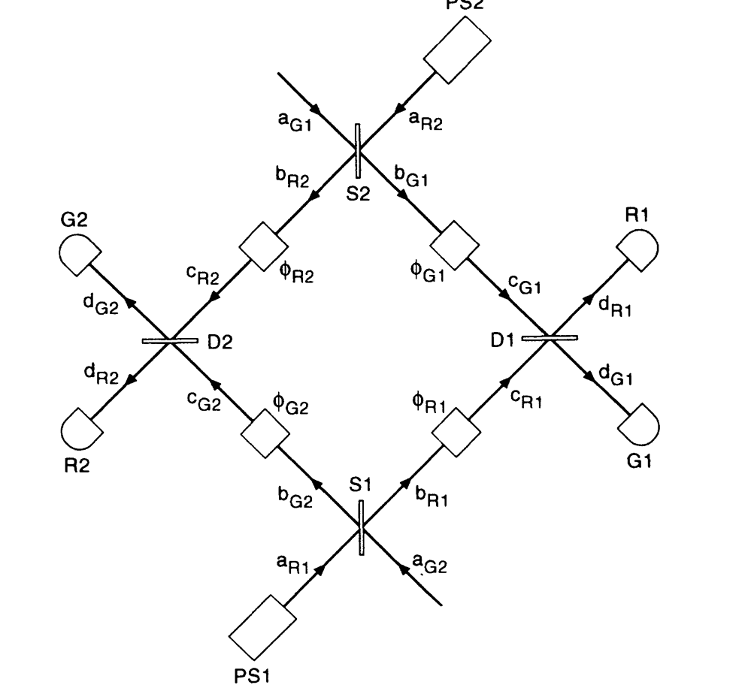
“The outputs of two independent-particle sources PS1 and PS2 are fed into the input ports of the beam splitters S1 and S2, respectively. Vacuum enters the other inputs of S1 and S2. The outputs of these two beam splitters propagate to two detectors. Detector 1 consists of phase shifters fG1, and fR1, the beam splitter D1, and the particle counters R1 and Gl. Similarly, detector 2 consists of phase shifters fG2, and fR2, the beam splitter D2, and the particle counters R2 and G2. The labels R and G are chosen to be reminiscent of the red and green lights that Mermin employs in his EPR gedanken experiments….”
“Each of these beam splitters entangles the particle entering one input port with the vacuum entering the other input port…. To derive Bell’s inequalities it is useful to consider a topological distortion of the apparatus depicted in Figs. 1… to the form depicted in Fig. 2(b}. “

“That is, by bringing the two sources together the apparatus resembles that used in the usual Bell’s-inequality experiments. One can then ignore the details of how messages are generated by the two sources and simply talk about messages received by the detectors from a central source.” (Yurke and Stoler 1992, 2229-2230)
From Cosmic Entanglement to a Cosmic Substance?
As we’ve seen, it is possible for multiple substances to be entangled. In fact, depending on the details of cosmology, it might be that all the world’s substances are jointly entangled. Assuming that we want only negative non-locality, entangled entities must exercise essentially unified joint powers. If multiple substances cannot acquire such essentially unified joint powers, then we would be forced to posit (the real possibility of) a cosmic substance. If no substance can be a proper part of another, this would entail that we (and other organisms) are not substances at all.
The Unity of (Some) Groups
For both Aristotle and Thomas Aquinas, groups of substances can be unified—not by the per se unity that’s characteristic of substances, but by a unity of order. E.g., cities.
Crucial question: can groups of substances so unified possess and exercise fundamentally joint causal powers? (I.e., causal powers that are not wholly grounded by or reducible to the powers of their constituent substances.)
The U. S. Senate has the power to declare war. Is this an irreducibly joint power of the Senators? Yes.
Political Entanglement and Negative Non-Locality
Suppose that the Congress passes and the President signs a bill depriving a certain class of citizens (including me) of the power to vote in federal elections. The effect on my powers is instantaneous (superluminal). I have lost that power before I can be aware of the loss. In contrast, it is arguable that I cannot acquire a new political power without being informed that I have it, and so positive non-locality is impossible.
What Grounds Such Joint Powers?
They must be grounded by some accident (a quality of some kind) that is irreducibly an accident of the whole group. Individual accidents are a way for individual substances to be. They have inesse, not simple esse. Similarly, a group accident would be a way for a group of substances to be (jointly).
How do such group accidents differ from substantial forms? Equivalently, how such groups differ metaphysically from individual substances?
Definitional Completeness
A substance has an essence that is definitionally complete: a real definition of the substance makes no reference to anything other than the substance itself and definitionally incomplete things (parts of substances and accidents).
Proper parts of substances and accidents do not have such definitionally complete essences. Their real definitions refer to the whole substance.
Groups have no essences at all. They do not belong to natural kinds. Or, if they do, their real definitions refer to things that already have definitionally complete essences (substances).
 The Analytic Thomist