Let me turn next to proposition 3, the incommensurability of basic goods. As I mentioned at the beginning, I will distinguish between weak and strong incommensurability. Weak incommensurability refers to the incommensurability of different goods in the short term, in a single moment (synchronic incommensurability). Strong incommensurability would entail that there can be no rational grounds for sacrificing one good now for another good, even when taking the long term into account (diachronic incommensurability). I’m not completely convinced by the NNL arguments for weak incommensurability, but I agree that it is a plausible doctrine, and I won’t challenge it here.
NN Lawyers argue for incommensurability on the grounds that there is in two distinct basic goods no common denominator (like quantity of pleasure or intensity of desire) that could ground a preference for one good over the other. Presumably, this is compatible with the principle of preferring Pareto-optimal packages. That is, if I can attain more of one good without suffering any loss of any other good, then the preference is rationally justified.
My definition of the human constitution assumed that acquiring goods now can affect one’s acquisition of other goods in the future, by sustaining some of one’s essential causal powers. It seems plausible to suppose that acquiring a balanced set of goods in the short run would be a necessary condition for attaining any basic goods in the long run. If I pursue goods in a highly unbalanced way, completely neglecting some basic goods in a single-minded pursuit of others, this will cause the deterioration of my character, resulting ultimately in a loss of my capacity to attain any basic goods.
Here’s a graph that illustrates the short-term tradeoffs between two basic goods, like play and friendship. In many cases, I can increase both play and friendship together, but there will be a Pareto-optimal frontier. Along this frontier, any further increase in friendship will require a loss of play, and vice versa.
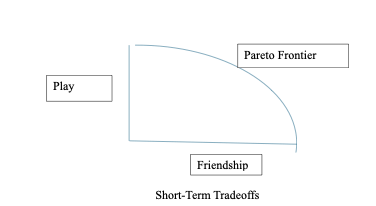
Short-Term Tradeoffs
However, when we take the long term into account, the structure of the choice is very different. Sacrificing all play for friendship in the short run will diminish my capacity for both play and friendship in the long run, as would sacrificing all friendship for play.
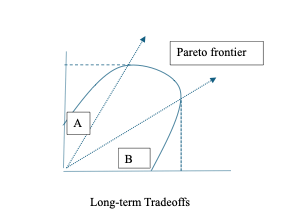
Long-term Tradeoffs
The Pareto-optimal frontier now lies between the two rays, which represent the limits of a proper balance between the two goods in the long run. An unbalanced life would fall short of the Pareto-optimal frontier, either into region A (relatively too little friendship) or region B (relatively too little play). Consequently, it is rational to sacrifice one basic good in the short turn for another, and we have thus disposed of NNL proposition 3.
 The Analytic Thomist